June 23 is National Typewriter Day. Members of the Mid South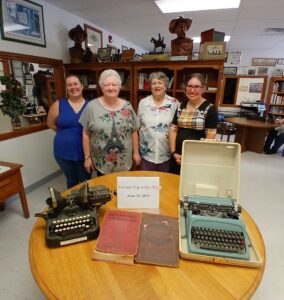 Writers gathered at the Barry County Museum last week to look over the museum’s impressive collection of antique typewriters.
Why bother to pay homage to the typewriter? Of course, it’s the forerunner of our modern word processors. When I get frustrated with my computer while writing, I remind myself what it was like to type term papers on a manual typewriter.
The first typewriter proven to have worked was built by the Italian Pellegrino Turri in 1808 for his blind friend Countess Carolina Fantoni da Fivizzano. Carey Wallace’s 2010 novel The Blind Contessa’s New Machine is based on the relationship between the Countess and Turri. (https://site.xavier.edu/polt/typewriters/tw-history.html).
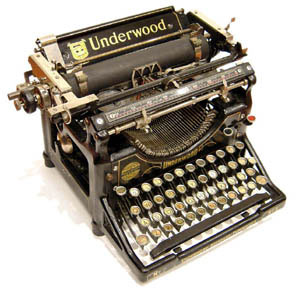 Christopher Sholes invented the first practical typewriter and introduced the keyboard layout that is familiar today—often referred to as the QWERTY keyboard after the first six letters from the left in the top row. I remember an Underwood like the one on the left from my childhood. They were produced from 1900 to about 1932.
Ever wonder why we have such a bizarre layout of keys, as opposed to a simple alphabetical layout? As Sholes experimented with his invention, he discovered that the letters would jam when the keys were arranged in alphabetical order. The layout he developed intersperses less-frequently used letters with the more common ones. Nevertheless, even a moderately fast typist could jam a typewriter with the common “type basket” style of keys. (I can vouch for that personally!)
I learned to type at the insistence of my mother when I was in 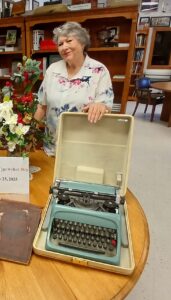 7th grade. I used a Smith Corona portable, which looked a lot like the one on the right I carried this baby to a rodeo one night when I was in high school, so I could type my article in time to meet the late-night deadline for the Kansas City Times. Then it followed me to college where it was used for every term paper all the way through graduate school. (Does that give you a clue as to how old I am?)
I started my newspaper career in about 5th grade when I wrote a monthly 4-H column for the Johnson County, Kansas, newspaper. In high school, I wrote articles for the Kansas City Star Youth Page on a regular basis. How did I fall into that so young? My mother, of course. My grandmother was the switchboard operator for the Kansas City Kansan when my mother was growing up. Later Mom became a reporter for the same paper, and my father was a photographer. Mom taught me to write, and Dad taught me the photography.
In high school, I not only wrote for the Youth Page, I sometimes submitted photos, and had a few articles in the main paper. Photography became my 4-H project, and my Dad bought me a full set of used developing equipment. I developed my own black-and-white film and photos in my homemade darkroom.
The skills I learned from my parents proved useful in every job I had, even though I didn’t become a journalist until after my own kids were in school and I became a “stringer,” (free-lance reporter) for the Cassville Democrat.