Bay Star, Baby Planet
Until recently, humans wondered if Earth was the only planet of its kind in the cosmos. (I suppose some still believe that). In recent years, progressively more powerful telescopes have allowed us to peer into the amazing wonders of the universe. Now we KNOW that billions of other stars have planets around them. Some of those are even in the goldilocks zone—able to support water in liquid form. Though, even in our own solar system, we have learned water is not as scarce as we once thought it was. This week, two new amazing discoveries have been announced.
Baby Star:
Astronomers announced on the morning of July 21, 2025, that they’ve discovered a companion star in a tight orbit around the beloved red supergiant star Betelgeuse in the constellation Orion, the Hunter. Betelgeuse is the bright star in the upper left of the constellation.
Astrophysicist Steve Howell at NASA Ames Research Center in California led the team that made the discovery. The researchers used a speckle imager on Gemini North called ‘Alopeke’ (‘fox’ in Hawaiian).
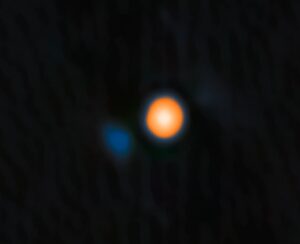 The companion appears to be an A- or B-type pre-main-sequence star, that is, a hot, young, blue-white star that has not yet initiated hydrogen burning in its core.
The companion is 6 magnitudes fainter than Betelgeuse and orbits close to Betelgeuse itself, within the supergiant star’s extended outer atmosphere.
Sadly, baby star probably may not a chance to grow up into a full-fledged star. Betelgeuse is a red giant, having already expended all (or most) of its hydrogen, and will eventually explode into a supernova. The companion star is located in the outer layer of Betelgeuse’s atmosphere.
Scientists have suspected for some time that Betelgeuse had a companion, and a study in 2024 indicated that if it did, it might not explode for a long time.
Image and information drawn from an article by Paul Scott Anderson in Earthsky.org July 22, 2025.
Baby Panet:
Astronomers may have caught a still-forming planet in action, carving out an intricate pattern in the gas and dust that surrounds its young host star. Using ESO’s Very Large Telescope (VLT), they observed a planetary disk with prominent spiral arms, finding clear signs of a planet nestled in its inner regions. This is the first time astronomers have detected a planet candidate embedded inside a spiral disk.
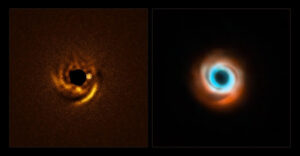
Francesco Maio, a doctoral researcher at the University of Florence, Italy, lead author of this study, said: “We will never witness the formation of Earth, but here, around a young star 440 light-years away, we may be watching a planet come into existence in real time.”
The potential planet was detected around the star HD 135344B, within a disk of gas and dust called a protoplanetary disk. The budding planet is estimated to be twice the size of Jupiter and as far from its host star as Neptune is from our sun. It has been observed shaping its surroundings within the protoplanetary disk as it grows into a fully formed planet.
Protoplanetary disks have been observed around other young stars, and they often display intricate patterns, such as rings, gaps or spirals. Astronomers have long predicted that these structures are caused by baby planets, which sweep up material as they orbit around their parent star. But, until now, they had not caught one of these planetary sculptors in the act.
Source: ESO: Unveiling a protoplanet candidate embedded in the HD 135344B disk with VLT/EEIS, posted by Earth Sky Voices July 23, 2025, on Earthsky.com